
Yellowstone
Bison now roam free in Yellowstone, the world’s first national park.
In late September of 2025, I joined a group of four accomplished photographers for a photography workshop led by Kathy Lichtendahl in and around Yellowstone National Park. My hope was to see a part of the U.S. that was new to me, learn some new skills, and return home with some fun wildlife shots and distinctive landscape images.
Buckle up for a pile of fresh images and interesting facts about nature….
I flew in to Bozeman, Montana and made the four-hour drive to our home for the next six days -- a guest ranch in the tiny town of Crandall, Wyoming, where we had home-made breakfasts and dinners each day and packed our own lunches as we set out to explore the region.
On our first evening, we shot the Milky Way over Swamp Lake ... my first try at photographing the night sky. The bit of light pollution that you see in the image is coming from Cooke City, a town over 18 miles away!
Traveling from sea level in Hawaii, I found myself a bit out of breath as we hiked at several locations above the tree line with an altitude of over 11,000 feet. Add to that some 40-mile-per-hour whipping winds, 36-degree temperatures, and uneven terrain ... and you can understand why my smile was a frozen one.
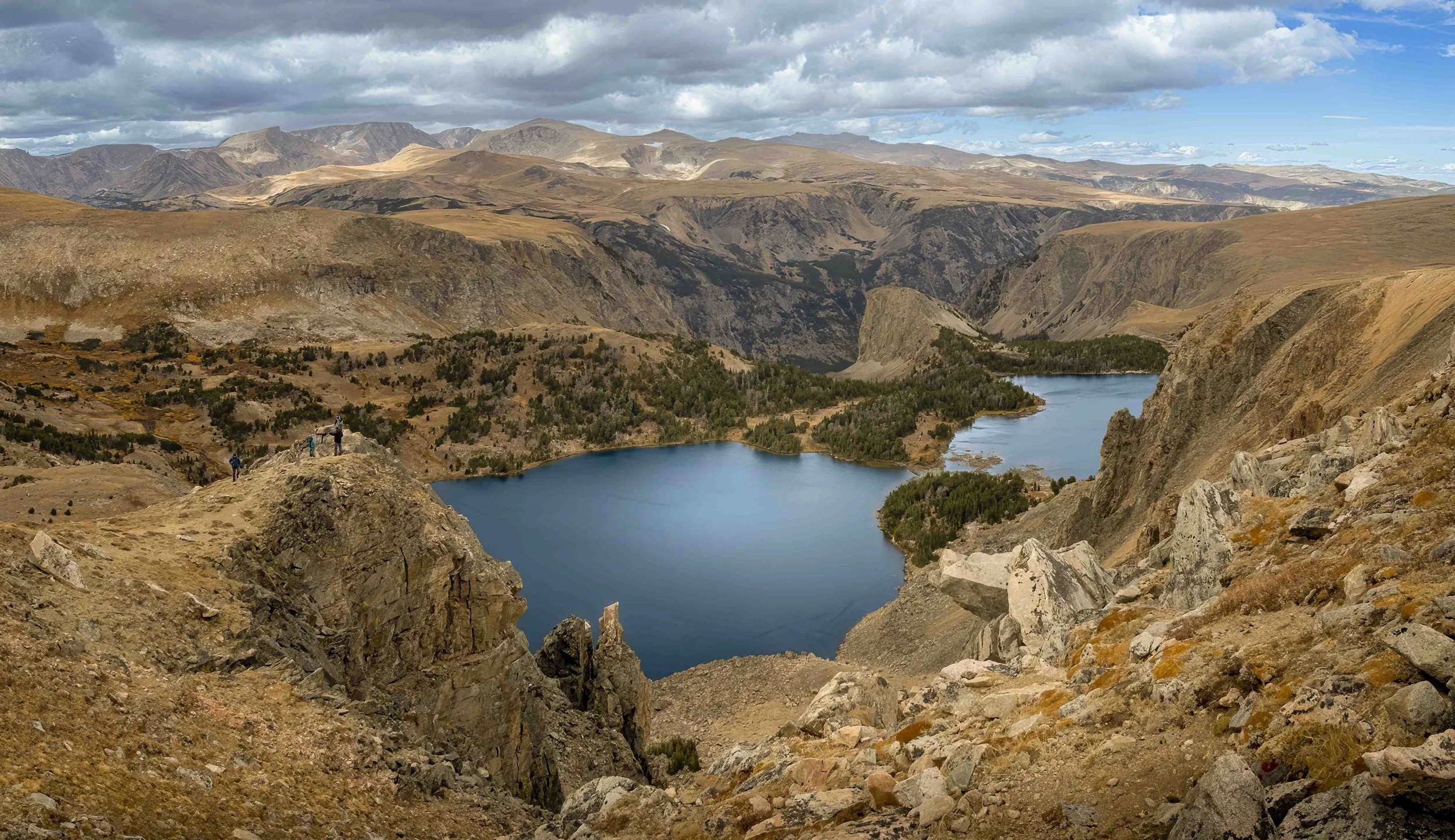
Cruising along the Beartooth Highway, which we did, you’ll cross the 45th parallel and find yourself at the exact halfway point between the North Pole and the equator, and that’s where you’ll discover this view of one of the area’s 50 lakes. Divide Lake is so named because it’s on the dividing line between Wyoming and Montana.
I learned that grizzlies can outrun a horse, so it’s best to photograph them from a safe position. I got this shot from inside our vehicle. Yes, it's real!
You may have seen my birding travelogue from Bosque del Apache. I find avian photography challenging and rewarding. Yellowstone did not disappoint in that regard. I saw hawks, ravens, eagles and more. As juveniles, red-tail hawks (bottom left) don’t yet have their distinctive red tails, but they sure are striking. I met an assortment of ravens, which I had assumed were black. It turns out they are many shades of blue. This large raven was perched in an evergreen tree; others find it easier to spot their lunch by joining you at your picnic table. I also spotted my first bald eagle along Lamar River and it was glorious. We also stopped to photograph a group of young Trumpeter swan cygnets gliding in the late afternoon sun. These three graces looked timeless in black and white.
After we photographed a waterfall, our leader said, “Let’s go find some mountain goats” as if trekking after wild goats were the most natural thing one would do on any given day.
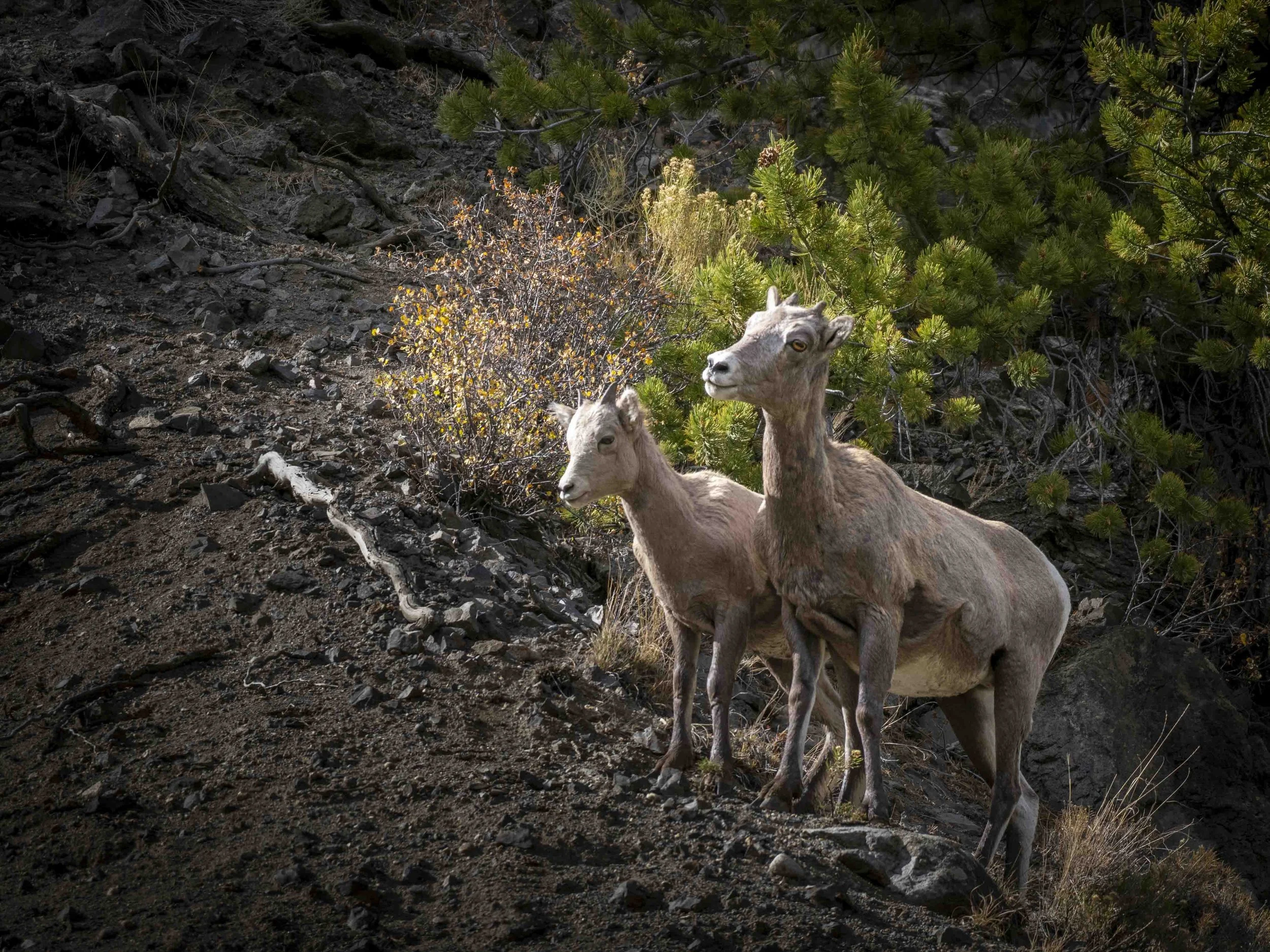
Not three minutes later, we spotted two pairs of bighorn sheep, each consisting of a ewe and a lamb, as if they were just the most natural thing you’d find on any given day. Apparently, at least one thought I was rather fascinating, and perhaps not the most common thing it would discover on any given day.
Bonus fun fact: Horns are permanent characteristics of sheep and goats. Antlers, on the other hand, are shed each winter and are regrown each spring. (And based on my very scientific and totally expert observation, I think the females should be called littlehorn sheep.)
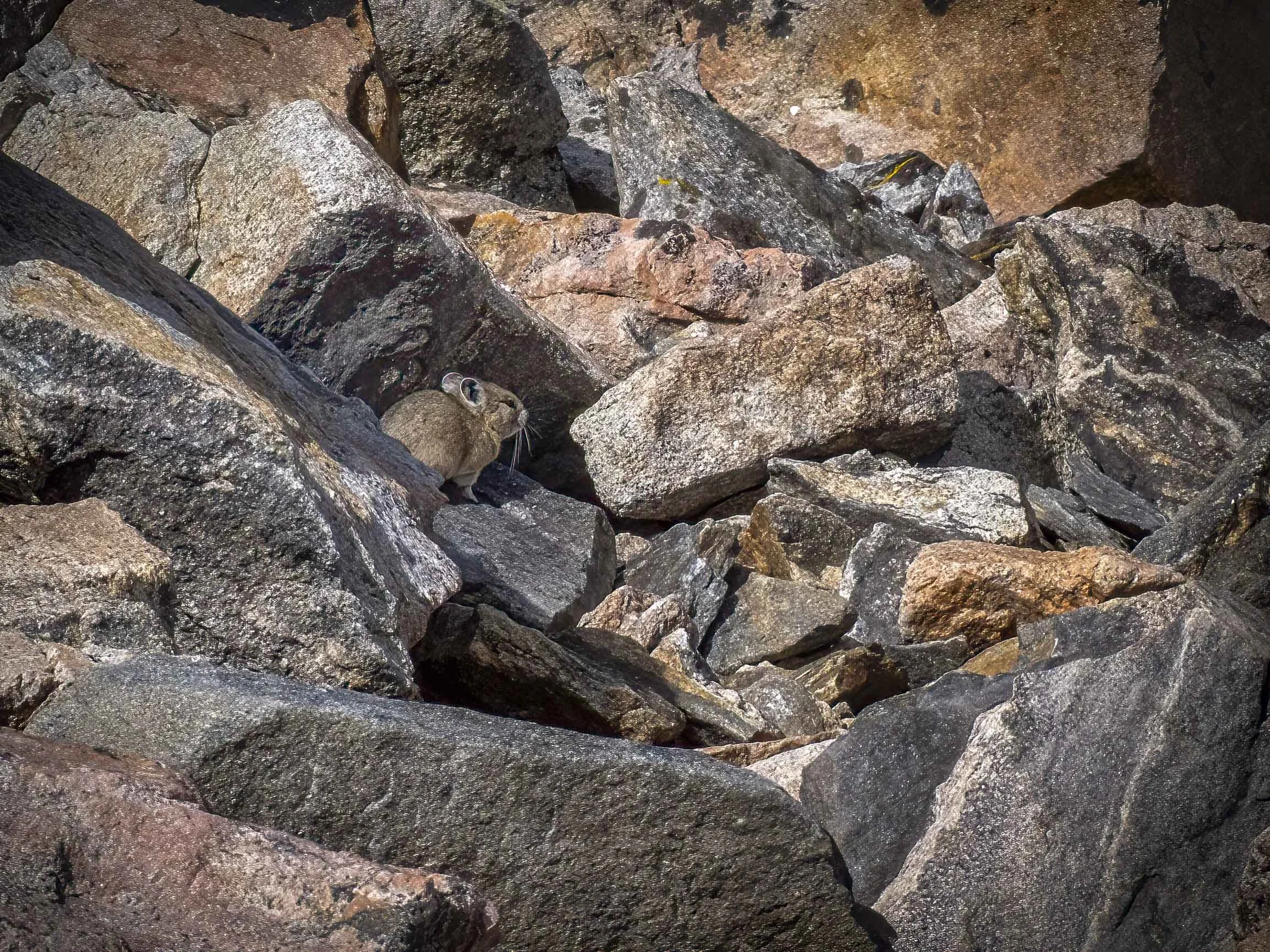
Exposed rocks are inhospitable habitats for most living things, but piles of granite rocks are where you will find the illusive pika, mistakenly characterized as a rodent. Members of the rabbit family, pikas are cute, furry creatures the size of your fist. They have no tails, move extremely fast, and blend into their surroundings (with the exception of their prominent mouseketeer ears trimmed in white).
Speaking of speed, Pronghorn are ungulates (hoofed animals) capable of reaching speeds up to 60 mph (the fastest of any mammal in North America). They have the body shape of a deer with long legs, short tail, and a long snout.
The bison population in Yellowstone, after being nearly extinct decades ago, has increased to over 6,000 in recent years. Traveling in groups, these herbivores are voracious eaters, so you most often see them with their heads down grazing. I was fortunate to get some interesting shots of bison confronting cars, taking over the road, crossing streams, and rolling around in the dirt.
We practiced some slow shutter speed shots to get silky water images. This one was taken at the unfortunately named Dead Indian Creek.
Next, I tried to capture the so-called Weeping Wall by featuring a waterfall emerging from the bottom of a granite cliff face.
I had some fun experimenting with intentional camera movement while I captured the aspen trees and the evergreens.
Lodgepole pines near some hydrothermal areas look as if they are wearing white anklet socks, at one time called “bobby socks.” These dead trees soak up the mineral-laden water. When the water evaporates, the minerals are left behind, turning the lower portion of the trees white. Despite their being dead, I found them to be attractive.
This fence is designed to keep snow off the nearby highway. Many of the park’s roads are closed for the eight-month-long winter, rather than being plowed.
We skipped the “Old Faithful” part of Yellowstone, but we did catch some thermal features at Dragon’s Mouth.
On one last stop before returning to the airport, we stood in a spot where Ansel Adams is said to have positioned his camera to photograph Pilot and Index peaks from the riverbed (though I haven’t been able to find his image from this locale) along Highway 212. This is my homage to the great landscape photographer.
Thanks for joining me on this expedition.
P.S. My friend Bob loaned me a collapsable walking stick, which came in handy for hiking on unstable terrain. Upon returning to the airport for my flight back, I couldn’t get the pole to collapse, so I used it as a cane to get early boarding. :) Thanks, Bob!